Healthcare Mobile App Development Guide
The shift, from digital front door to digital care delivery, is reshaping what healthcare apps need to do.
Patients expect tools that monitor chronic conditions, connect them to providers in real time, and surface insights that improve outcomes. That’s why mHealth apps are projected to reach $86.37 billion by 2030, growing at a 14.8% CAGR.
But growth brings scrutiny. With the FDA's stricter 2025 cybersecurity guidelines, "move fast and break things" is now a liability. A healthcare app today is judged by its ability to protect patient data and deliver results.
This guide breaks down what it takes. If you'd rather skip straight to building, Mojo Trek's healthcare app development services can help.
The 4 Types of Healthcare Apps Driving Growth
Right now, four segments are attracting the most investment and generating the strongest returns.
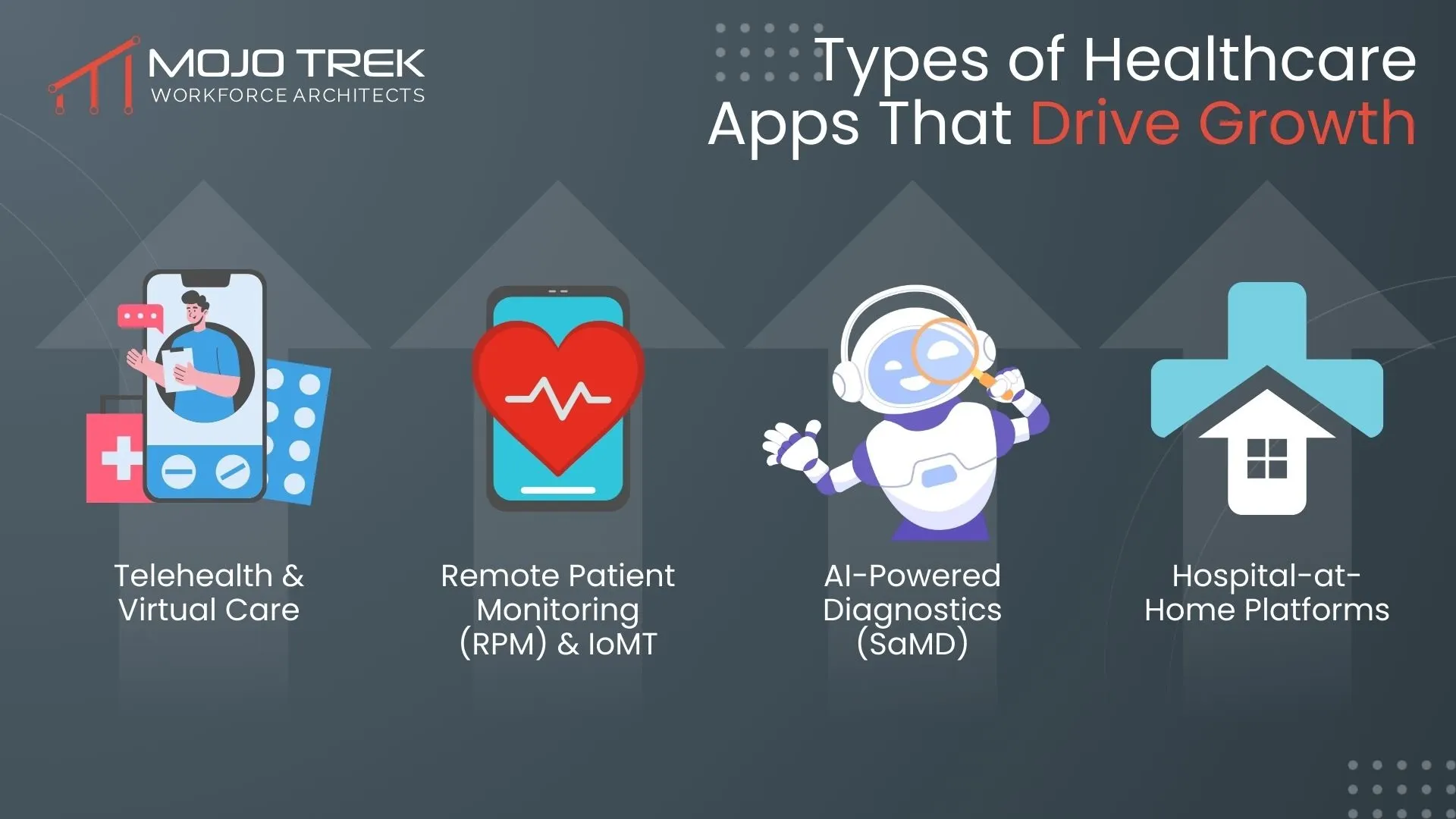
1. Telehealth & Virtual Care
Telehealth has evolved well beyond video consultations to incorporate asynchronous messaging, AI-assisted triage, and remote diagnostic capabilities that let providers evaluate patients without scheduling a live session. The convenience factor drives adoption, and the clinical efficiency keeps health systems invested.
2. Remote Patient Monitoring and IoMT
Apps that connect to continuous glucose monitors, blood pressure cuffs, and cardiac monitors are the fastest-growing segment in digital health. These devices, collectively known as the Internet of Medical Things (IoMT), transmit patient data to providers in real time. Medicare now reimburses for these services, turning remote monitoring from an operational cost into a billable revenue stream.
3. AI-Powered Diagnostics (SaMD)
Software as a Medical Device uses machine learning to detect conditions like diabetic retinopathy, skin cancer, and cardiac arrhythmias from images or sensor data. Such apps flag abnormalities fast, often with comparable accuracy to specialists. The tradeoff is regulatory complexity. Most AI diagnostic tools require FDA 510(k) clearance or De Novo classification, adding months and high cost to development timelines.
4. Hospital-at-Home Platforms
These apps monitor patients after they leave the hospital. They track vitals, medication adherence, and symptoms during the critical first days and weeks. If readings show a problem, care teams can step in early with a telehealth check, a medication adjustment, or a nurse visit. That keeps patients from ending up back in the ER and hospitals off Medicare's penalty list. Readmissions within 30 days trigger fines that can run into millions annually.
Compliance & Security in 2026

Before your app reaches a single patient, it needs to pass three gatekeepers: security audits, FDA requirements, and hospital IT.
Data Breach Reality
According to IBM's 2025 Cost of a Data Breach Report, the average healthcare data breach costs $7.42 million, the highest of any industry for the 15th consecutive year. These breaches also take the longest to detect and contain, averaging 279 days from intrusion to resolution.
New FDA Rules
In June this year, the FDA released updated cybersecurity guidance requiring any "cyber device" to include a Software Bill of Materials (SBOM) documenting all components, dependencies, and known vulnerabilities.
Manufacturers must also demonstrate ongoing vulnerability monitoring and patch management throughout the product lifecycle. Non-compliance is a prohibited act under the FD&C Act, meaning violations can trigger criminal prosecution.
Apps without secure-by-design architecture get rejected from the App Store, blocked by hospital IT departments, and denied FDA clearance. Fines are the least of your problems.
Essential Standards
In the US, HIPAA governs patient data privacy and security. In Europe, GDPR applies. If your app handles payment or integrates with enterprise systems, SOC 2 Type II certification signals operational trustworthiness to potential partners. And for any app that needs to exchange data with electronic health records like Epic or Cerner, HL7 FHIR is the interoperability standard that makes integration possible.
The only way to ensure security is baked in is to hire engineers with healthcare experience from the start. Retrofitting compliance is expensive, slow, and often impossible.
Outsource Your HealthTech to MojoTrek
Need a partner who understands HIPAA and HL7? Mojo Trek delivers full-cycle software development services to help you launch secure medical apps on time and within budget.
Key Features That Define Top Apps in 2025
What separates apps that get adopted from apps that get abandoned? They solve a real problem without creating new ones.
AI-Driven Personalization
Users expect apps to adapt care plans, recommendations, and alerts based on their own data. A diabetes app that gives the same advice to everyone will lose to one that adjusts meal suggestions based on glucose patterns, activity levels, and medication timing. The AI in healthcare market is growing at nearly 39% annually, set to reach $37 billion, because buyers now assume "smart" is standard.
Interoperability
Most US hospitals run on electronic health record systems like Epic and Cerner, and clinical workflows live inside them. Any app that creates extra work or requires duplicate data entry will be abandoned. HL7 FHIR APIs allow apps to read from and write back to these EHRs, and federal mandates under TEFCA require standardized access to clinical data across networks. Without FHIR integration, hospital IT departments will block your product before clinicians ever see it.
Offline Mode
Home health workers in rural areas, patients in underserved communities, and field clinicians all need apps that function without a constant internet connection. Offline-first architecture with smart syncing is a baseline requirement for any app serving populations outside urban centers.
Accessibility
Your app must be usable by patients with visual, motor, or cognitive impairments. WCAG 2.2 compliance is the standard, and failing to meet it is now a legal risk. ADA lawsuits targeting inaccessible digital health products are on the rise. Over and above compliance, accessible design simply makes apps easier to use for everyone, including elderly patients and those managing complex conditions.
Step-by-Step Development Process

From regulatory strategy through to clinical validation, here's how to build a healthcare app that ships.
Step 1: Discovery and Regulatory Strategy
Is it a wellness tool or a medical device? The FDA classifies Software as a Medical Device (SaMD) differently from general wellness apps, and the distinction changes your budget, timeline, and compliance requirements. A wellness app that tracks steps can ship in months. A diagnostic tool that detects arrhythmias may require 510(k) clearance, clinical trials, and a regulatory budget three times the size.
Step 2: UI/UX Design
Healthcare apps aren't used in ideal conditions. Users log medications at 3am, check glucose levels while distracted, or navigate symptoms while feeling sick. The interface needs to work under stress. Day 30 retention sits around 3-4% for most apps, and even top-performing fitness apps struggle to hit 12%. If your UX adds friction, users will leave.
Step 3: Secure Engineering
Encryption at rest and in transit is baseline. Two-factor authentication is mandatory. Every data flow must be mapped and protected. Healthcare apps are high-value targets, and security shortcuts will surface in audits, penetration tests, or worse, in breach notifications.
Step 4: Testing and Validation
Penetration testing exposes vulnerabilities before attackers do. Clinical validation answers a harder question. Does the app improve health outcomes? Without that evidence, you have a product. With it, you have a defensible market position.
How Much Does It Cost? (2025 Estimates)

Healthcare app development costs naturally depend on what you're building and how much regulatory complexity is involved.
MVP (Wellness App): $50,000–$80,000
A HIPAA-compliant app with basic tracking, user authentication, and simple notifications. No EHR integration, no video, no AI. This gets you to market fast, but the feature set is limited.
Advanced App (Telehealth/Integration): $100,000–$250,000
Add video consultations, EHR integration via FHIR APIs, appointment scheduling, and multi-role access for patients and providers. The jump in cost comes from integration complexity and the additional security layers required for real-time clinical data exchange.
AI/SaMD Platform: $300,000+
If your app makes diagnostic claims or uses machine learning to inform clinical decisions, you're in FDA territory. Budget for clinical data validation, regulatory documentation, and the 510(k) or De Novo submission process. The technology is only part of the cost. The compliance work can match or exceed it.
Hidden Costs
FYI: Healthcare app development is not the finish line. Budget 15–25% of your initial investment annually for maintenance, including OS updates, security patches, and feature improvements. Add SOC 2 audits if you're selling to enterprise buyers, and penetration testing at least once a year. These costs are predictable, but they catch first-time founders off guard.
.webp)
Ship Compliant Software Faster
We provide custom development services for MedTech startups and healthcare providers. From patient portals to FDA-compliant diagnostic tools, our engineers build software that meets strict security standards.
(872) 895-79552026-02-09
Heading
Lorem ipsum dolor sit amet, consectetur adipiscing elit. Suspendisse varius enim in eros elementum tristique. Duis cursus, mi quis viverra ornare, eros dolor interdum nulla, ut commodo diam libero vitae erat. Aenean faucibus nibh et justo cursus id rutrum lorem imperdiet. Nunc ut sem vitae risus tristique posuere.
(872) 895-7955.svg)
Frequently Asked Questions
What is the difference between a health app and a medical device (SaMD)?
A health app tracks general wellness data like steps, sleep, or calories. It doesn't diagnose or treat disease. A medical device, or Software as a Medical Device (SaMD), does. If your app uses an algorithm to detect a heart arrhythmia or flag early signs of skin cancer, the FDA considers it a medical device. That classification triggers regulatory requirements, including 510(k) clearance and clinical validation.
How long does it take to build a HIPAA-compliant MVP?
A HIPAA-compliant MVP takes three to four months for a basic app with user authentication, encrypted data storage, and core functionality. Add EHR integration or video consultations, and the timeline extends to six months or more.
Do I need FDA approval for my health app?
General wellness apps that track fitness or nutrition don't require FDA approval. But if your app diagnoses conditions, recommends treatments, or uses algorithms to inform clinical decisions, the FDA classifies it as Software as a Medical Device (SaMD). That means you'll likely need 510(k) clearance or De Novo classification before you can go to market.


Our Latest Insights

What Is Software Outsourcing? A Complete Guide.
How to Build a FinTech App: Development Guide